
Climbing a telecoms mast means trained climbers, safety procedures, and hours of work on a tower the network depends on. A drone survey covers the full structure — from base to tip — in a single flight, with 360-degree coverage of every face and antenna position, while the tower stays live throughout.
The survey photographs steelwork condition, antenna arrays, mounting hardware, and cabling in detail, and compiles every finding into a report the network team can act on directly.
What does a telecoms tower survey cover?
Steelwork corrosion and coating failure, loose or missing bolts and fixings, antenna damage and alignment, mount condition, lightning protection, cable and tray condition — and guy wire tension and anchor condition on guyed masts.
See what a full-coverage survey includesDoes the tower need to go off air?
No. The drone operates at a safe standoff distance from the structure and does not interact with antennas or feeders, so the tower stays in service throughout the survey. This matters when the mast carries multiple operators on shared infrastructure.
Discuss your tower portfolioDo you verify line of sight between masts?
Yes. When a network expansion depends on an unobstructed radio path between two points, a line-of-sight survey establishes visibility and the minimum tower height needed at each end — completing that survey stage before site acquisition or construction begins.
See how a line of sight survey is flownDo radio transmissions interfere with the drone?
High-power radio environments are a real consideration for any drone operation, and flight planning accounts for them. The survey is planned around the mast’s transmission characteristics so the drone is flown where interference risk is lowest — protecting both the flight and the asset.
More about our approach to safety










A single flight covers the structure from base to tip, with 360-degree passes of every face and antenna position. What the survey typically detects: structural corrosion and coating failure on steelwork, loose or missing fixings, lightning protection condition, and cable and tray condition — plus guy wire tension and anchor condition on guyed masts.
What about working at height regulations in Ireland?
The Safety, Health and Welfare at Work (Work at Height) Regulations 2006 (S.I. No. 318 of 2006) require that work at height be avoided where it is reasonably practicable to do so. A drone survey satisfies this at the first step of the hierarchy of control — no climber leaves the ground, so the duties for fall protection and rescue do not arise.
More about our regulatory complianceHow long does a tower survey take?
A full-coverage survey is typically completed in a few hours, where a climbing inspection can take a day or more once rigging, safety checks, and ascent and descent times are included.
Discuss your survey requirements
High-zoom photography captures close-up detail of antenna arrays, mounting hardware, feeders, and connectors while the drone remains at a safe standoff. This is where degradation often shows first — corrosion at mount fixings, damaged radomes, misaligned antennas — and where a climbing inspection is slowest and most intrusive.
What detail can the survey resolve on an antenna?
The survey can resolve mount condition, fixing corrosion, damaged or missing radome elements, and obvious misalignment of panels — enough detail for the network team to plan the repair visit without a separate look.
See what a full-coverage survey includes

Before a new mast goes up — or a microwave link is added between existing ones — the radio path between the two points must be unobstructed. A drone survey establishes visibility and the minimum tower height required at each end, so the link can be planned and priced with certainty.
How does the drone survey verify line of sight?
The drone climbs vertically at the proposed antenna location and the pilot confirms the far tower through the camera — no climber on the mast, no walking a survey line across the terrain. For minimum build height, the drone descends in steps and the moment line of sight is lost is recorded directly, giving an exact height rather than an estimate.
Discuss your link requirements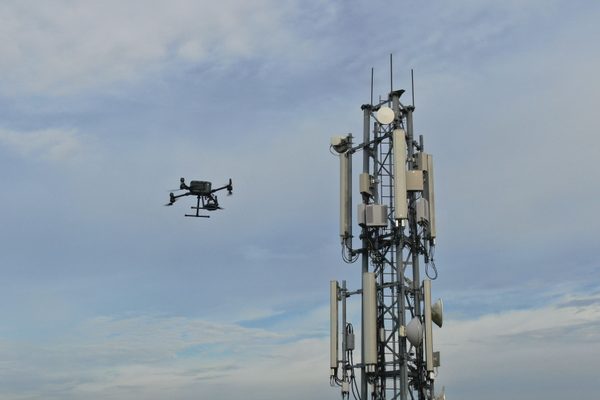
No climbers at height, no rigging, no rescue arrangements — the survey satisfies S.I. No. 318 of 2006 at the first step of the hierarchy of control.
Every face and every antenna position photographed from base to tip in a single flight — no face missed, no angle assumed.
A full-coverage survey is typically completed in a few hours, where a climbing inspection takes a day or more including rigging and safety checks.
The condition of lightning protection and grounding is recorded in the same survey — a statutory concern for tall structures.
Flights are planned around the mast’s transmission characteristics, so the drone operates where radio interference risk is lowest.
Every finding photographed and located on the structure, so the network team plans repairs without a second visit.
A climbing inspection of a lattice tower takes a day or more once rigging, safety checks, and ascent and descent times are included. A drone survey typically covers the full structure in a few hours — which makes routine, repeatable inspection realistic. More frequent surveys mean defects are caught before a corroded fixing becomes a failed mount.

Every finding is photographed and GPS-referenced, so the network team knows exactly which face, which mount, and which fixing needs attention — without sending a climber up to look again. Thermal imagery of electrical components can be added where overheating is a concern.
When choosing a drone company to complete your inspection, it's vital to work with experts. Radio waves from towers interfere with a drone's internal system. Inexperienced pilots are at risk of crashing the drone and damaging expensive towers. Engineers with Drones are experienced, knowledgeable pilots. We take all risks and potential interferences into consideration when inspecting.
Tell us what you need to know, and we will work with you to design actionable deliverables that give you the outcomes you need.
A typical tower inspection delivers a full photographic survey of the structure from base to tip and an annotated condition report with GPS-referenced defects. Thermal imagery of electrical components can be added where applicable.
Findings are compiled into a structured report the network team can act on directly — each defect photographed, described, and located, ready to hand to a rigging or maintenance contractor.
Every face and antenna position photographed from base to tip in a single flight.
Each defect photographed, described, and located for the maintenance team.
Every finding positioned on the structure, so repairs can be planned without a return visit.
Thermal passes over electrical components where overheating is a concern.
Complex surveys and inspections require more than just a pilot. Our engineers can help you scope your requirements and indentify the right approach.