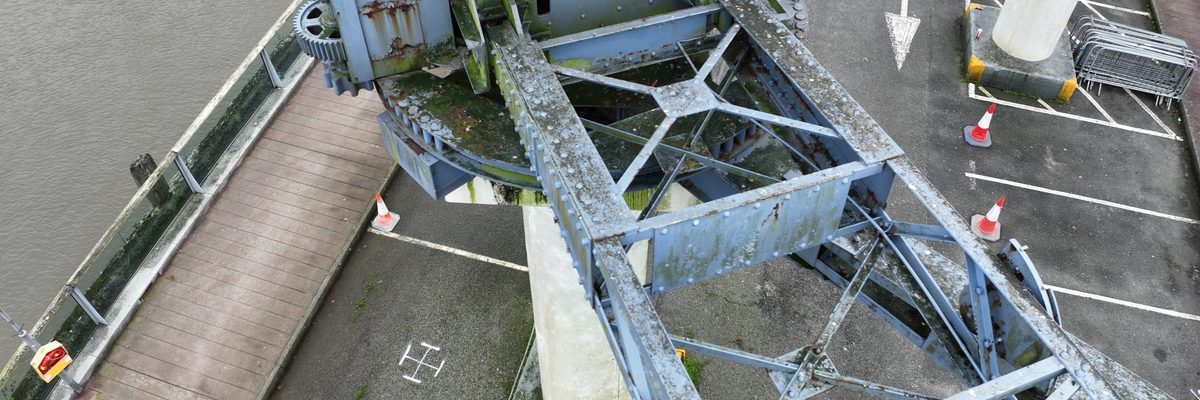
Aerial view of the full lattice framework of the old ship-loading crane on Waterford City docks

Old crane inspection in Waterford

A riveted steel ship-loading crane in the centre of Waterford City docks, captured in full and delivered as a high-resolution 3D model with a detailed defect report.
Overview

The Job at a Glance

A photogrammetric survey of an old ship-loading crane in Waterford City docks. The whole riveted steel structure was captured, inside and out, and delivered as a high-resolution 3D model, a defect inspection report and a spreadsheet of every defect found.

Waterford City docks

A large static crane in the middle of Waterford City, mounted on three concrete plinths and built to lift cargo on and off ships.

A riveted steel lattice

Most of the original structure remains, with only the cables gone. A complex lattice that demands careful photogrammetric capture.

Orbits of every component

Overview and tight-in imagery, captured within the lattice as well as externally, with sensitive areas recorded in extra detail.

Three deliverables

A defect inspection report, a high-resolution 3D model, and a spreadsheet of every defect for the client's asset management.

Background

A ship-loading crane that has outlived its docks

In the middle of Waterford City, on the docks, stands an old ship-loading crane. It was active in the early part of the last century, moving cargo on and off ships, but the docks are no longer in use and the crane has been left in place. It is a large, static structure with a great deal of lifting capacity.

The crane is built from riveted steel, and most of it is still there; only the cables are gone. The client asked Engineers With Drones to inspect the crane and produce a three-dimensional model of the entire structure.

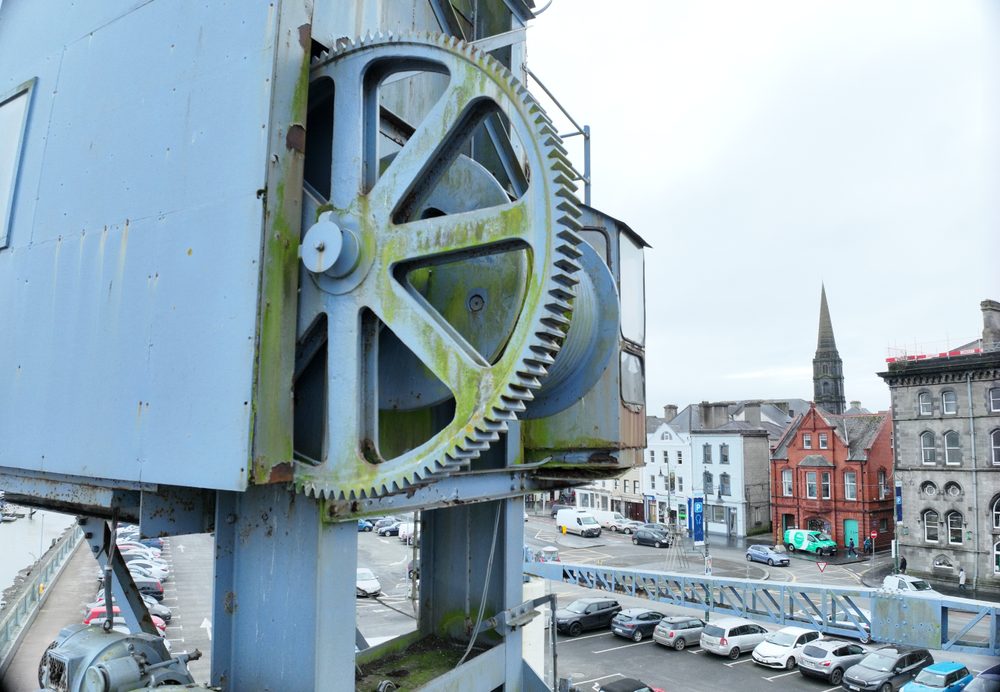
A weathered pulley wheel on the crane framework with the town waterfront behind
A large, weathered pulley wheel still in place on the crane, with the town waterfront behind.
The challenge

Flying in the middle of a working city

Operating in the middle of a city was the first consideration. To perform the work safely, the area around the crane was cordoned off so the team could operate without uninvolved people being close to the drone. A full cordon was in place all around the crane while the data was captured.

The airspace also needed to be checked. The site falls within Waterford Airport airspace, but the crane is not a very high object, so the operation sat below the level of concern and within the safe open-category area of the geo-zone there.

The structure

A lattice that resists easy modelling

The biggest technical challenge was the structure itself. Monolithic structures such as buildings are relatively easy to turn into a photogrammetric 3D model, but lattice structures and complex structures like electrical towers or cranes are far more demanding. If they are not captured correctly, the model develops distortion and artifacting, with ballooning and a rough, poor-quality finish.

The way the data is captured, where it is captured, and the conditions it is captured in all matter, and the mechanism of capture has to be chosen with the lattice in mind.

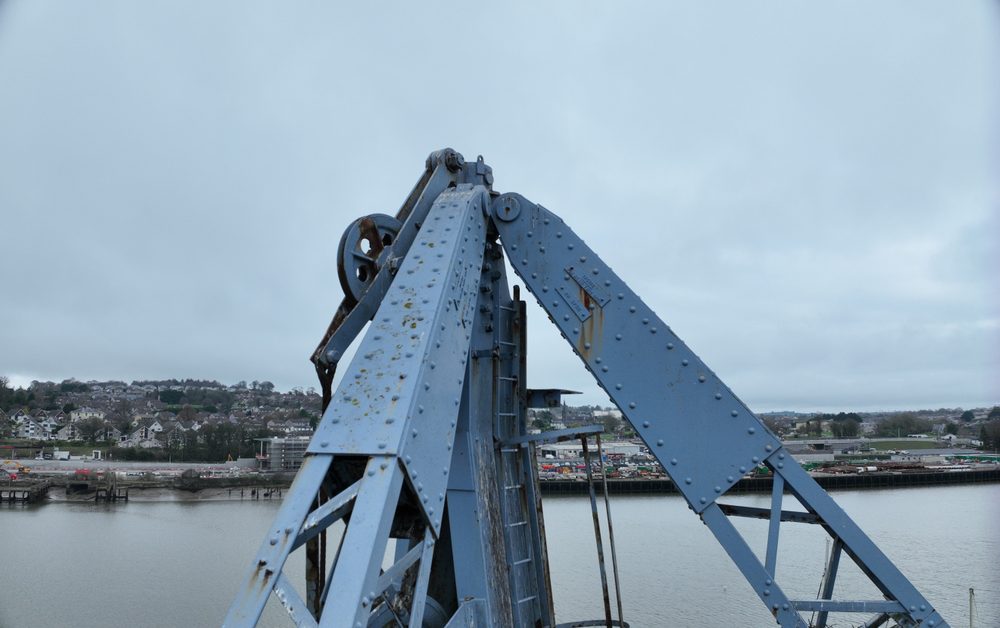
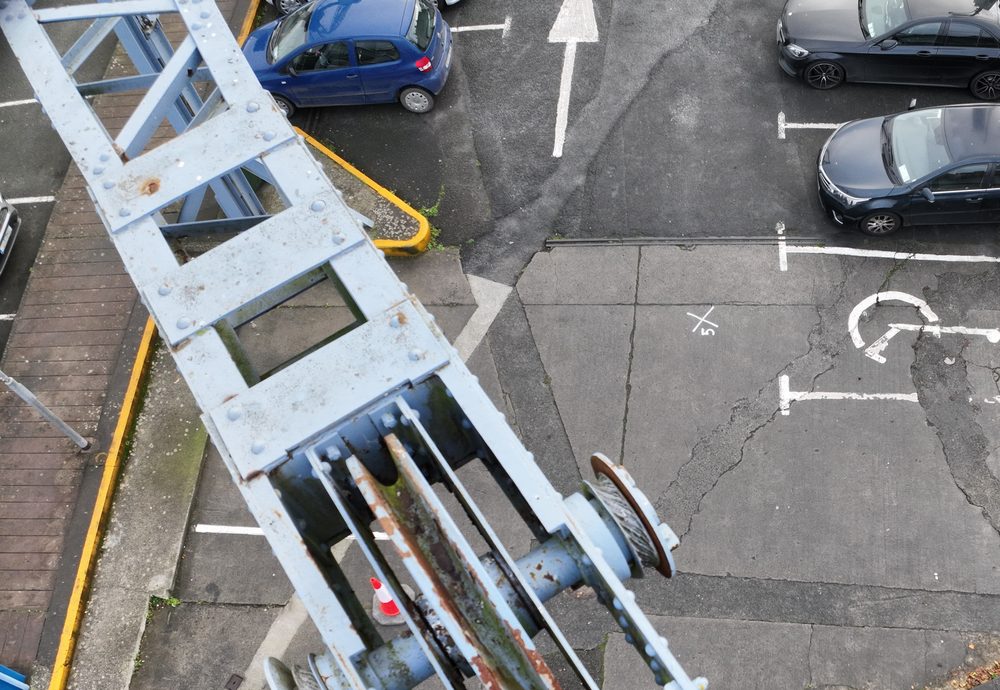
View up along the length of the crane's lattice jib from beneath
The open lattice of the crane jib seen from below, the kind of structure that needs careful capture to model cleanly.
Methodology

Capturing the lattice from every angle

The usual principles of photogrammetric capture were used, combining overview imagery with tight-in imagery. The overview imagery helps build the model, while the tight-in imagery refines it and adds the detail. Because of the complexity of the structure, a great deal of detail was captured.

The entire crane was flown using those principles, with as much imagery captured within the lattice structure as externally. Orbits of every component were carried out to cover all the relevant areas of detail, and any areas that were particularly sensitive from a structural perspective were captured at even higher detail again.

Back at the office, the data was processed into a three-dimensional photogrammetric dataset. That was probably the more complex part of the job, but with the right processes and software it was completed successfully.

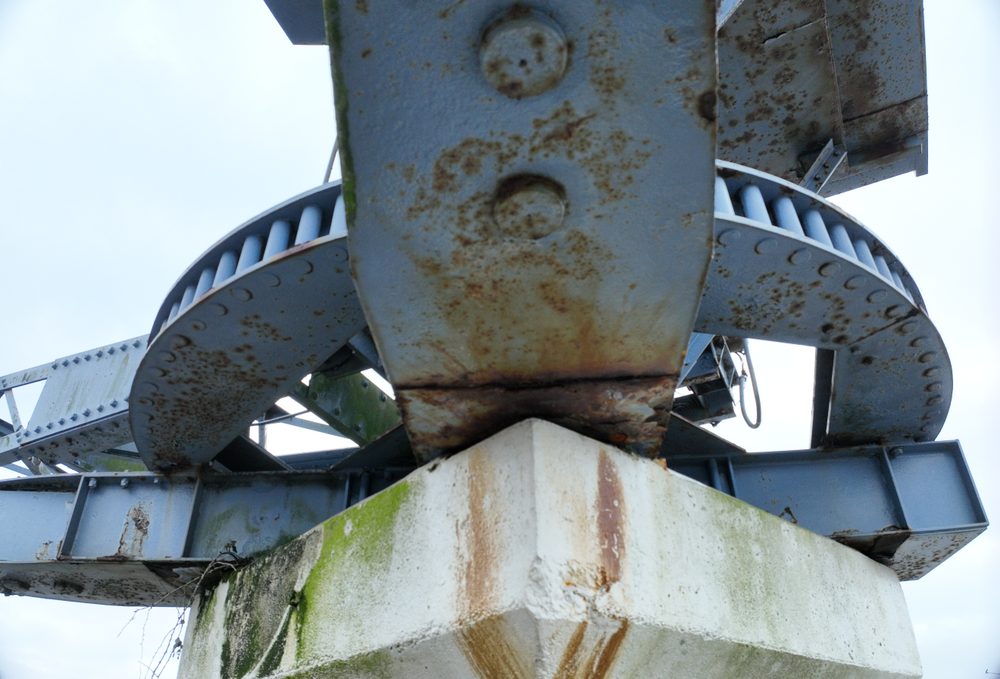
Low-angle close-up of the crane's main rotational gear mechanism and concrete base
Close detail of the crane's main rotational gear mechanism and concrete base, captured as part of the survey.
Deliverables

A model, a report and a defect register

The client received three separate deliverables, which together made up the complete package.

High-resolution 3D model

A photogrammetric model of the entire crane. The resolution is fine enough to identify individual fasteners and rivets, and to tell where rust has rusted through the structure, where corrosion is present, and where the metal is still intact.

Defect inspection report

A detailed report covering the condition of the structure and the defects identified across the crane.

Defect spreadsheet

Every defect logged in a spreadsheet the client could import into an asset management system or a list of works.

Outcome

Detail that reads the condition of the steel

The 3D model was of such a resolution that individual fasteners and rivets could be easily identified. It was possible to tell where areas of rust had rusted through the structure, where corrosion was present, and where the metal was still intact with no damage. All of that detail was brought together into the model, the report and the defect register.

The purpose of the inspection was not to plan a dismantling. These old steel structures were built to last, with a great mass of metal, and the client wanted to confirm that the crane could be left standing rather than taken down. The client was very happy with the outcome.

Aerial view of the old ship-loading crane from above, with the river to the left and a car park below and to the right
The crane seen from above in its city setting, with the surrounding roads and car park below.
Comparative methodology

Why they chose us

An old ship-loading crane in the middle of a city, built as a complex riveted lattice, needed a full inspection and a complete three-dimensional record. The client wanted to know whether the crane could safely remain standing.

Site access
Flown from a cordoned area vs access at height

The drone covered the whole structure safely from the ground, with a full cordon around the crane and no need for people to work at height.

Detail
Individual rivets identifiable vs visual checks

The model resolves individual fasteners and rivets, and shows where rust has rusted through the steel.

Deliverable
3D model plus defect register vs inspection notes

A measurable 3D model, a defect inspection report and a spreadsheet of every defect for the client's asset management system.

Efficient option Our method

Using a drone

A photogrammetric survey of the entire crane, flown under a full cordon in the middle of the city and captured within the lattice as well as externally.

  • A complex lattice captured in full The whole riveted steel structure was captured using photogrammetric principles, inside the lattice and out.
  • Orbits of every component Each component of the crane was orbited to capture every relevant area of detail.
  • Extra detail where it matters Areas that were particularly sensitive from a structural perspective were captured at even higher detail.
  • Rivets, rust and corrosion visible The model identifies individual fasteners and rivets, and distinguishes rusted-through and corroded areas from intact steel.
  • A complete 3D record A measurable model, a defect report and a spreadsheet of every defect were delivered together.
Project status Completed — 3D model, report and defect register delivered
Manned approach Traditional method

Without a drone

A traditional inspection of a tall lattice structure would rely on rope access or a mobile elevating work platform to reach each part of the crane, with the structure's height and open lattice making close, systematic inspection slow and costly.

  • Rope access or a platform for every area Reaching each member of a tall riveted lattice would need rope access or a mobile elevating work platform, set up repeatedly around the structure.
  • Inspection work at height Engineers would work at height to inspect individual members, adding time, cost and risk to every visit.
  • Limited views into the lattice A person at height still sees the structure from a limited set of angles, making it hard to inspect the inside of the lattice and behind every member.
  • No measurable 3D record A traditional survey records what the inspector sees, without producing a measurable 3D model of the whole structure that can be revisited later.
Operational impact Repeated access setup, no 3D record
Let's talk

Speak to an engineer about your project

Complex surveys and inspections require more than just a pilot. Our engineers can help you scope your requirements and indentify the right approach.

Talk to an engineer

+353 (0)21 202 8281

Quickest for technical scoping

Email your brief

info@engineerswithdrones.ie

Best for sending detailed specs

Next steps

Where to find out more

You can find out more about our 3D mapping and photogrammetry services, or read about our port crane inspection in Cork. Alternatively, you can contact us here.

Last updated: