Internal inspection of a 70-metre industrial stack Confined space inspection without human entry, shutdown, or cooling-down period. Client anonymous.
Overview
The Job at a Glance
Internal confined space inspection of a 70-metre riveted steel industrial stack critical to 24/7 production operations. Inspection completed without human entry, production shutdown, or cooling-down period. Client anonymous - no location details, no external imagery.
Anonymous location (Ireland)
Client confidentiality is absolute - no identifying details, no external imagery of the stack.
70 metres tall
Section-by-section inspection with battery changes between segments, covering the full internal height.
4K video + LiDAR point cloud
Elios 3 confined space drone captured high-resolution video and dimensional 3D data simultaneously.
No human entry
No confined space permit, no decommissioning, no cooling-down period, no standby rescue team required.
The challenge
Critical infrastructure that cannot stop
As Bob Foley, founder of Engineers With Drones, explained: "This stack is key to their production, that is to say if the stack isn't functional, they do not produce."
The stack operates 24 hours a day, 7 days a week. Any extended shutdown for inspection would halt the entire production line. The structure itself is 70 metres tall - a riveted steel construction with an internal protective coating, substantial I-beam support structure at the base, and multiple probes penetrating into the interior.
External cladding on the outside obscured any visual inspection from the exterior, making internal inspection the only viable approach to assess the condition of the riveted structure, panel joints, protective coating, and reinforcing rings.
Human entry would have required a confined space entry permit, decommissioning of the stack, a cooling-down period (the stack had to cool for a day before access was possible), and a standby rescue team. More critically, it would have required production to stop.
Technology
Confined space drone technology - Elios 3
Bob Foley explains why a caged drone is essential: "A confined space drone by definition is a caged drone. And what do I mean by that? So if you take any drone in the world and you just touch the prop, it will fall out of the sky instantly."
The Elios 3 is specifically designed to operate in enclosed spaces without GPS. The protective cage allows the drone to bounce off walls and surfaces during flight without crashing, which is essential for navigating the interior of a narrow vertical structure.
The Elios 3 carries a 4K video camera and a LiDAR sensor simultaneously. This combination delivers both high-resolution visual detail for defect identification and a dimensioned 3D point cloud showing the geometry of the stack interior and the location of every defect in three dimensions.
As Bob Foley notes: "Their only kryptonite is a long thin object like a probe, which can go through the cage, touch a prop, and then you got a problem." For that reason, the inspection was flown from the bottom upward - entering through the base hatch and flying straight up. On the ascent, the pilot has a clear view ahead and can see probes, sensors, and penetrations before the drone reaches them.
Methodology
Section-by-section methodology for tall structures
A 70-metre stack is too tall to inspect on a single battery. The interior was divided into sections based on the client's target areas of concern - the zones where they believed issues were most likely to exist.
The drone completed one section, was recovered for a battery change, then re-entered for the next section. Each section was captured with its reference height so the full interior record was contiguous. This approach ensured full battery capacity for each segment with time margins for careful inspection and re-examination of areas of interest.
Findings
What the inspection found
The inspection covered the full internal height of the stack, including the base support structure, bolted panel joints, internal protective coating, reinforcing rings, transition pieces, and all probes and penetrations. Findings were classified by severity and documented with both 4K imagery and LiDAR point cloud data.
Note: All images shown are internal views only from the confined space inspection. No external imagery is shown to maintain client anonymity.
Base support structure - good condition
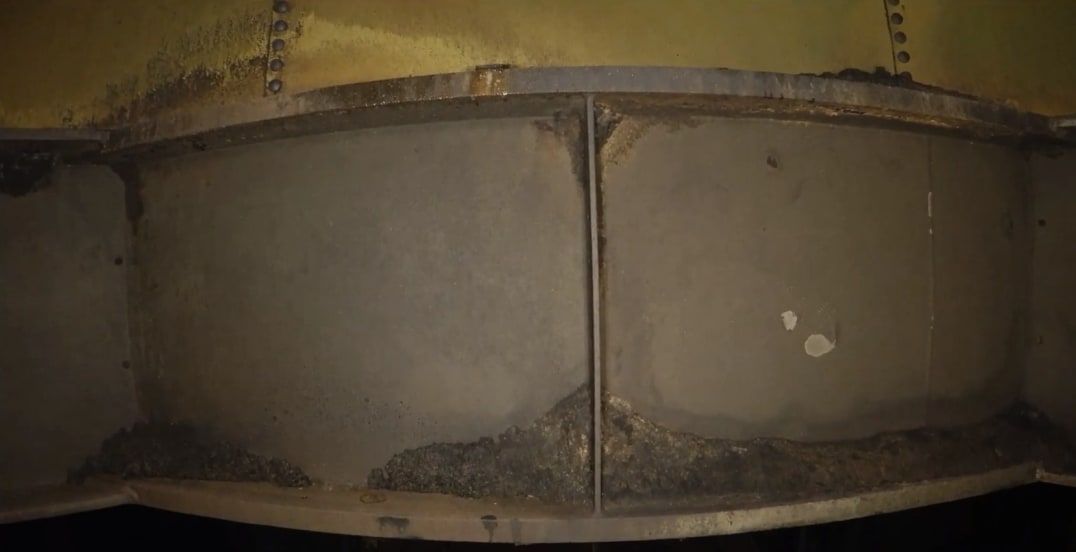
The substantial I-beam steel structural elements at the base of the stack were in good condition with no heavy corrosion visible. This structure holds up the entire 70-metre stack load and was confirmed to be sound.
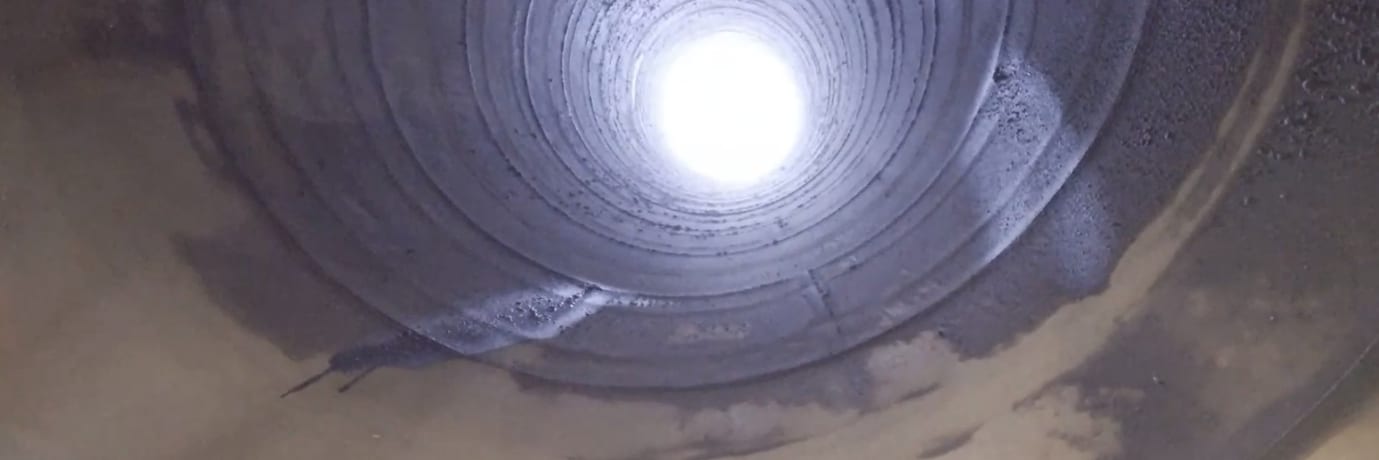
Looking up from the base, the steel support structure is visible at the bottom with the stack panels above.
The structural elements were thoroughly inspected during the initial section of the flight. The I-beam construction showed no signs of heavy corrosion or structural degradation - critical findings given that this structure bears the entire load of the 70-metre stack above.
The load-bearing I-beam structure at the base was confirmed to be in good condition with no heavy corrosion visible.
As Bob Foley observed: "It doesn't look heavily corroded, it looks in pretty good condition, which is good." This was a critical finding - any degradation of the base support structure would have been a serious structural concern requiring immediate attention.
Bolted panels and protective coating - variable condition
The bolted steel panels that make up the stack shell showed variable condition. The internal protective coating - which protects the steel structure from corrosion - was in reasonable condition in most areas. The drone was able to inspect all panel joints, bolt connections, and coating condition section by section throughout the full height.
The bolted steel panel construction visible throughout the stack interior, showing panel joints and connection details.
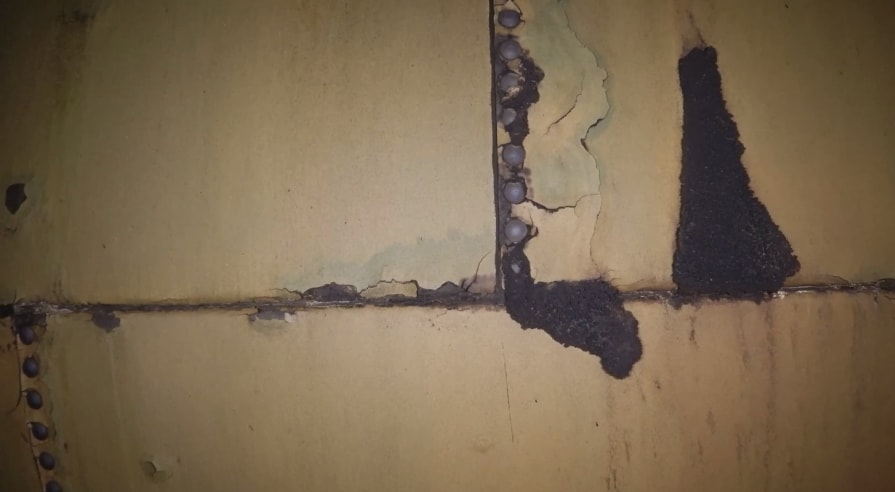
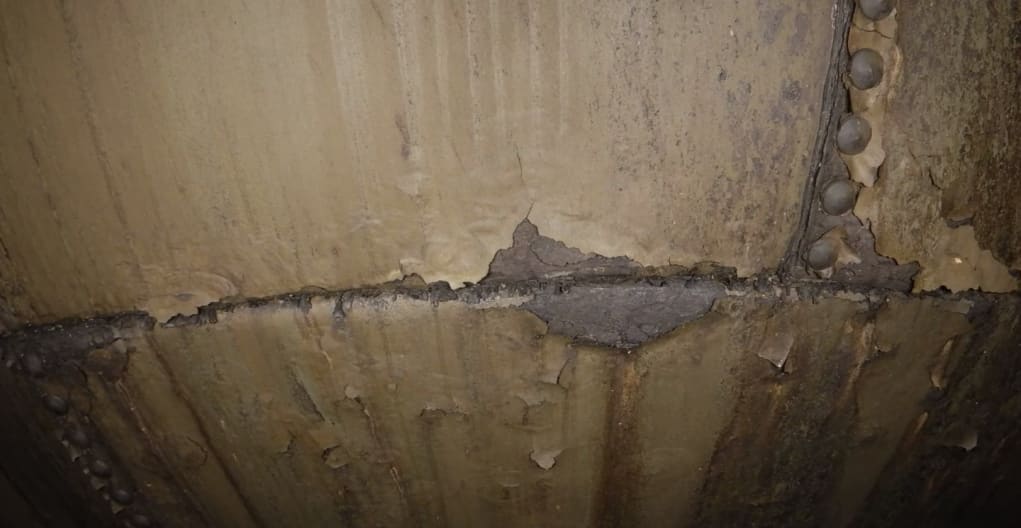
Scaled corrosion was identified in certain zones, but for the most part the general condition of the panels was acceptable. In areas where the protective coating was compromised, surface corrosion was visible on the steel panels and around bolt joints.
Areas where the protective coating has degraded show surface corrosion on panels and around bolted joints.
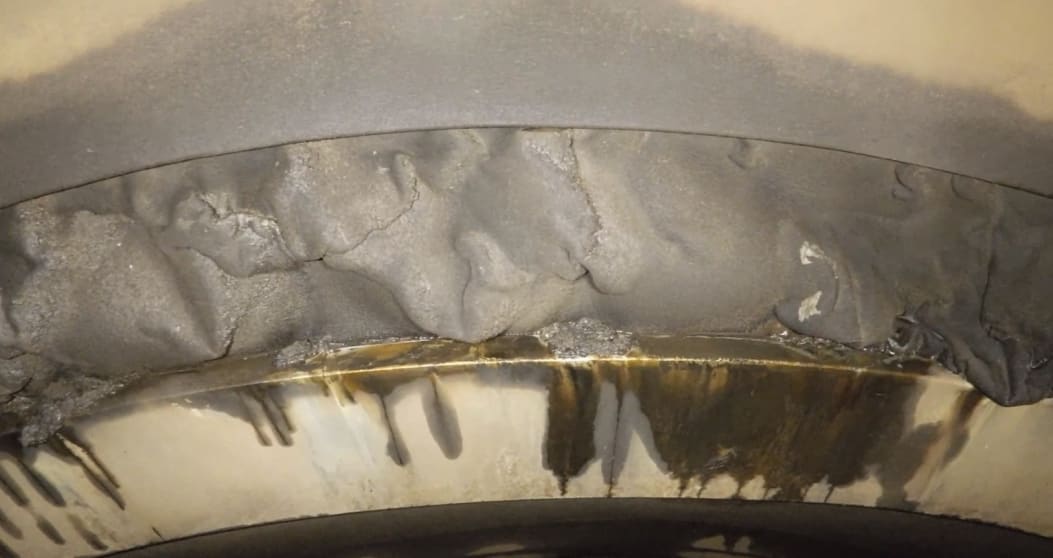
Reinforcing rings - moisture-trap corrosion
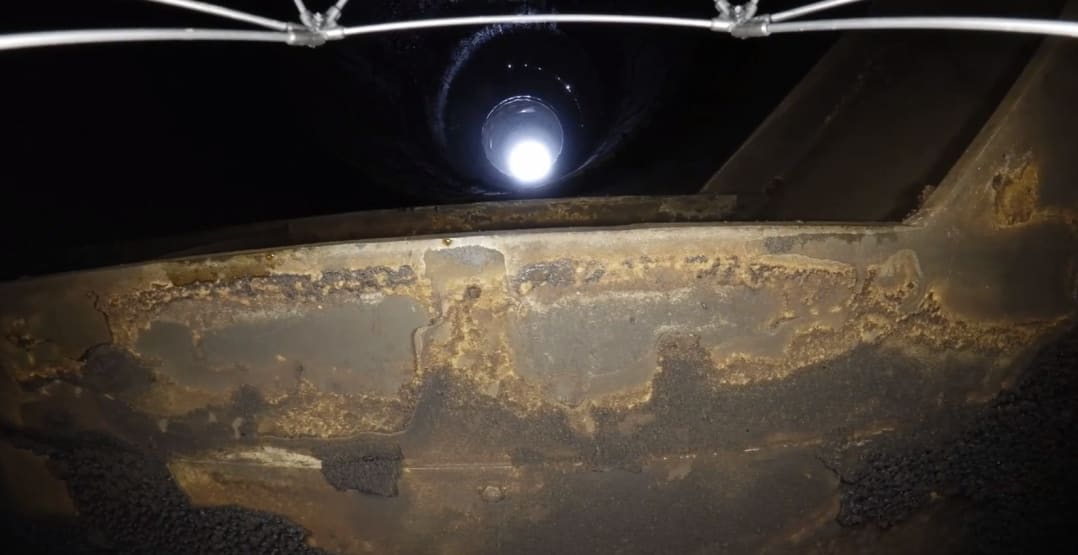
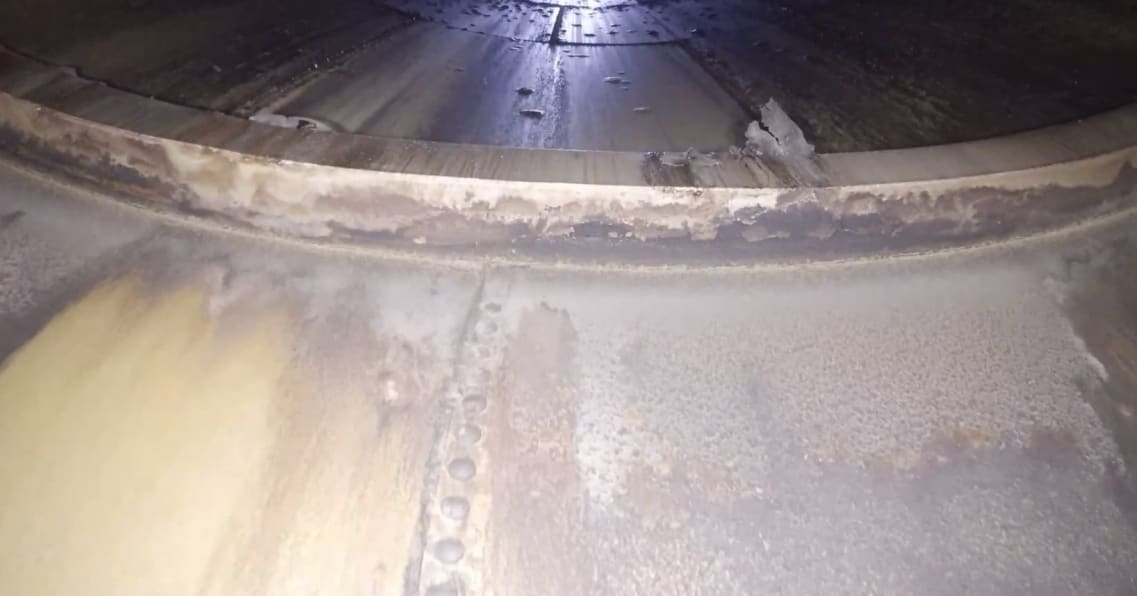
As Bob Foley explained: "These were not particularly well designed, if I recall, because they have an upward U-shaped to them which means they trap moisture coming down which means they're constantly holding debris and moisture in this area which causes rust corrosion."
The inspection identified corrosion in these areas as expected from this design characteristic. The reinforcing rings essentially act as moisture collectors, creating localised zones of accelerated deterioration.
Reinforcing rings with upward U-shaped profiles trap moisture and debris, causing localised corrosion.
Critical areas - through-thickness holes
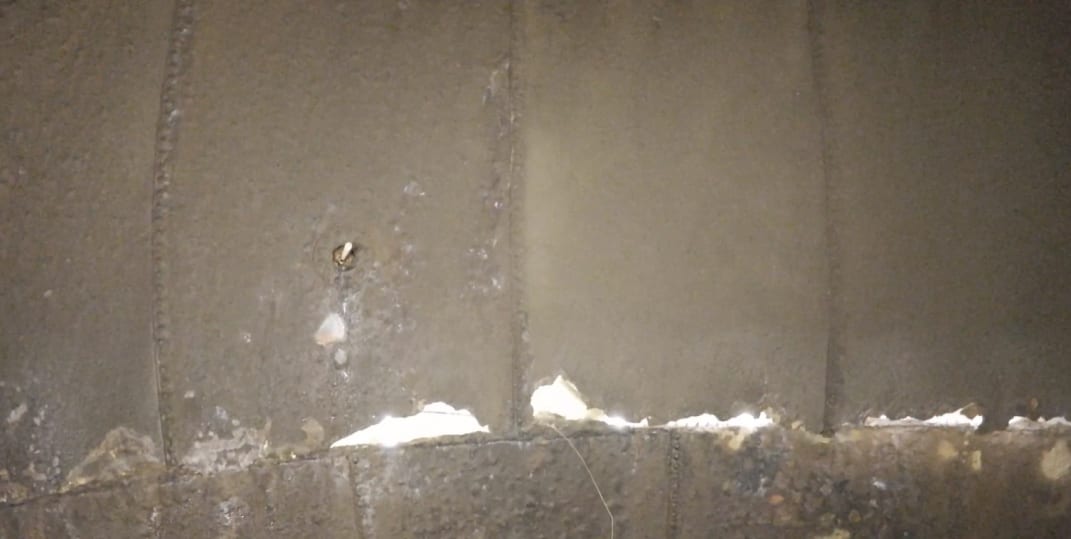
Bob Foley described the transition to the critical zone: "So then we got to the main area of concern and in case you're not seeing it there, we are no longer in an area of corrosion. We're now just holes straight through the structure."
In these specific zones, corrosion had progressed beyond surface scaling to complete perforation. The white areas visible in the imagery are holes straight through the steel panels. The client was aware of these issues and had external support structures in place.
The inspection provided the detailed documentation needed to prioritise and plan repair work. Every defect was located in the 3D point cloud, allowing the client to understand exactly where the problems were and what repair strategy was required.
Critical areas showed through-thickness holes in the steel panels - complete perforations requiring repair. The white areas visible are holes straight through the structure.
Transition pieces - redundancy confirmed
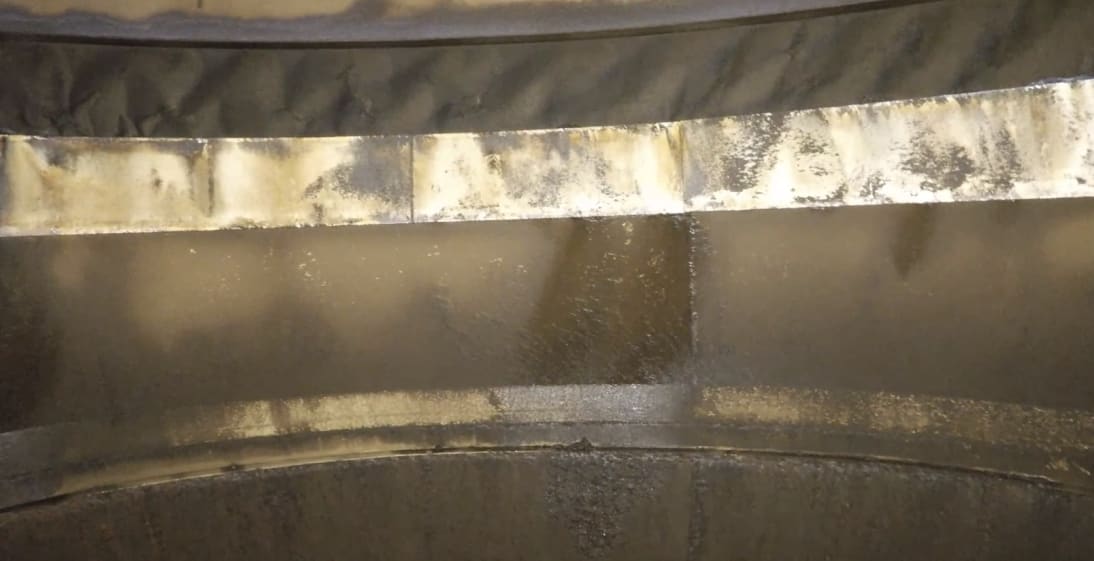
Transition pieces with flexible membranes separate independently supported sections of the stack, allowing the upper section to move independently from the lower section. The inspection identified the location and condition of these transition zones.
Transition piece visible where the stack narrows, separating two independently supported sections.
The flexible membranes at these transition points showed some issues on the internal surface, but the client confirmed that multiple membranes were in place for redundancy, so they were not concerned about that finding at the time.
The flexible membrane allows independent movement between sections, with multiple layers providing redundancy.
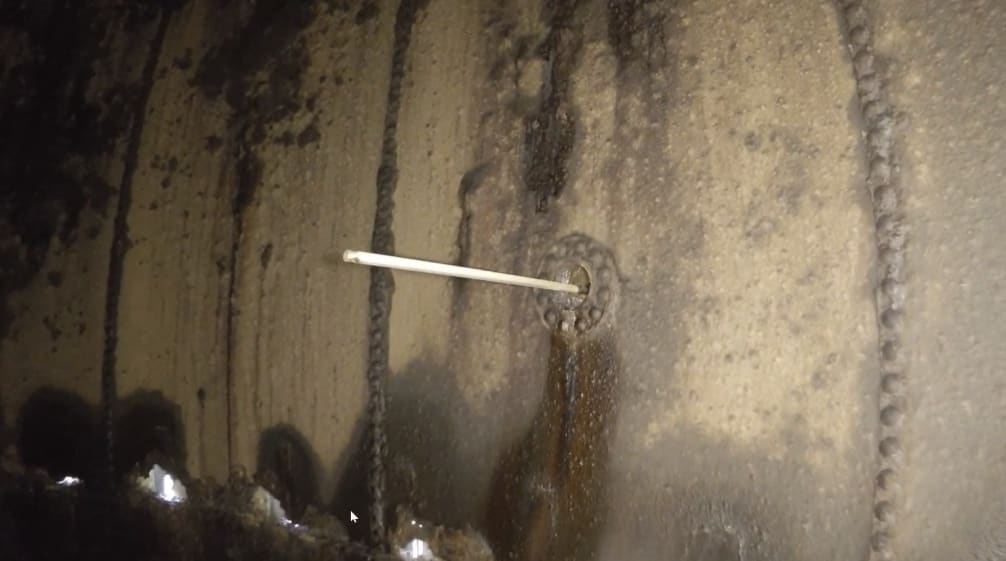
Probes and penetrations - careful navigation required
Multiple probes penetrate into the stack interior for monitoring and process control. Each probe was identified on ascent and inspected in detail. The condition around penetration points was checked for corrosion, and each probe was carefully navigated to avoid contact with the drone cage.
These probes represent the primary operational hazard for confined space drone inspection. As Bob Foley notes: "Their only kryptonite is a long thin object like a probe, which can go through the cage, touch a prop, and then you got a problem." For that reason, the inspection was flown from the bottom upward, allowing the pilot to see probes ahead before the drone reached them.
Probes are the primary operational hazard - a long thin object can penetrate the protective cage and contact a propeller if not carefully navigated.
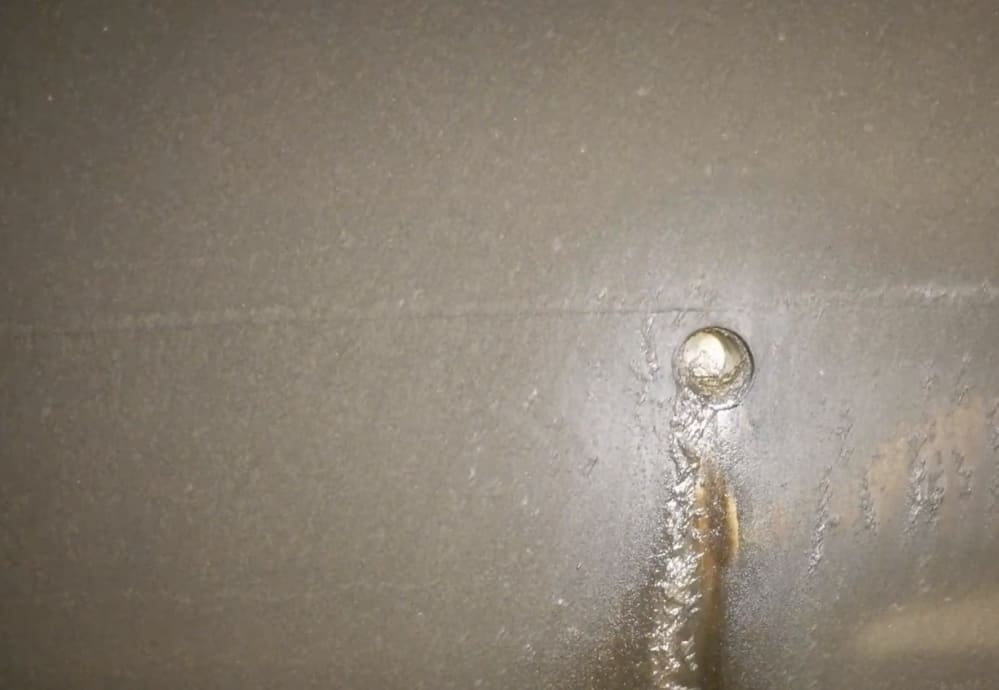
In addition to active probes, the stack contained unused probe holes from previous monitoring installations. These penetration points were also inspected to check for corrosion around the opening and to confirm they were properly sealed.
Unused probe holes from previous installations were inspected to check for corrosion around the penetration point.
Inspection footage
The 4K video footage captured during the inspection provides a comprehensive visual record of the stack interior, from the base support structure through the full 70-metre height to the transition pieces and probe penetrations at the upper sections.
4K internal inspection footage from the 70-metre industrial stack, captured using the Elios 3 confined space drone with simultaneous LiDAR point cloud scanning.
Deliverables
Report, imagery, point cloud, and diagram
The client received a full defect classification report with every defect described, categorised by type, and assigned a severity level. This allowed immediate prioritisation of repair work based on criticality.
All high-resolution 4K video and still imagery was provided, allowing the client to make their own interpretation of the raw data and see in granular detail exactly what was found.
The LiDAR point cloud illustrated the dimensions of the stack interior and showed where defects were located in three dimensions. This allowed the client to orientate themselves and understand the spatial relationship between different problem areas.
A simple diagram was prepared showing where the major problems were located - accessible to non-technical stakeholders without specialist software and ready to hand directly to maintenance or repair teams.
Outcome
Extensive repairs completed, stack now operational
Following the inspection, the client completed extensive repair work based on the findings. The stack is now fully operational with all identified defects addressed.
The inspection was completed without any production shutdown, no human entry into the stack at any point, no confined space entry permit, and no cooling-down period. The 24/7 operation continued throughout the inspection process, and the detailed findings allowed the client to plan targeted repairs rather than approaching the work blind.
This case study demonstrates the value of confined space drone technology for critical infrastructure inspection - particularly for assets that cannot be taken offline for extended periods and where human entry presents significant logistical and safety challenges.
Comparative methodology
Why they chose a confined space drone
For this industrial stack inspection, we chose the confined space drone approach because it delivered complete visual data on the 70-metre riveted steel stack without production shutdown, human entry into a confined space, or a cooling-down period.
Safety
Zero human entryvs confined space entry + rescue team
The confined space drone eliminated the need for any personnel to enter the stack. No confined space entry permit, no standby rescue team, and no exposure to hazardous internal environments.
Downtime
No production shutdownvs full shutdown + cooling-down period
The inspection was completed without stopping production or cooling down the stack. The 24/7 operation continued throughout — no extended downtime or lost production.
Data quality
4K video + LiDAR point cloudvs visual-only without dimensional data
Simultaneous 4K video and LiDAR point cloud capture provided high-resolution visual detail and dimensional 3D data, with every defect located, classified by severity, and documented.
Efficient optionOur method
Using a drone
A safe, efficient, and highly targeted solution using confined space drone technology.
No human entry into the stack at any pointThe inspection was conducted entirely remotely. No personnel entered the confined space, and no confined space entry permit or standby rescue team was required.
No production shutdown or cooling-down periodProduction continued at 24/7 throughout the inspection. No decommissioning, no cooling-down period, and no lost operational time.
Section-by-section inspection across the full 70-metre heightThe stack was divided into sections based on the client's areas of concern. Each section was flown on a separate battery, with 4K video and LiDAR captured for every segment.
4K video and LiDAR point cloud captured simultaneouslyThe Elios 3 carried both sensors at once, delivering high-resolution visual detail for defect identification alongside a dimensioned 3D point cloud of the entire interior.
Every defect classified by severity and documentedAll findings were categorised by type, assigned a severity level, and located in three dimensions within the LiDAR point cloud — enabling immediate repair prioritisation.
Client completed extensive repairs — stack now fully operationalThe detailed inspection data allowed the client to plan and execute targeted repairs. The stack is now fully operational with all identified defects addressed.
Project statusCompleted — stack fully operational
Traditional approachWithout a drone
Without a drone
The expensive, hazardous, and disruptive traditional approach.
Production shutdown requiredIf the stack stops, the entire production line stops. Any traditional inspection method would have required shutting down 24/7 critical infrastructure.
Cooling-down period requiredThe stack had to cool for a full day before human access was possible — adding significant delay before any inspection could even begin.
Confined space entry permit and standby rescue teamHuman entry into the stack would have required a confined space entry permit, decommissioning of the stack, and a dedicated standby rescue team on site.
Personnel exposed to hazardous internal environmentThe interior of a 70-metre industrial stack presents serious hazards — confined space, potential residual gases, and limited egress — all of which threaten personnel safety.
No dimensional data — visual-only assessmentWithout LiDAR point cloud capability, a visual-only assessment would lack the dimensional data needed to precisely locate and measure every defect in three dimensions.
Operational impactHigher risk, cost and downtime
Let's talk
Speak to an engineer about your project
Complex surveys and inspections require more than just a pilot. Our engineers can help you scope your requirements and indentify the right approach.